
What is innovation?
Innovation has become a buzzword. A look at where the term comes from, where its limits lie, and what innovation has to mean in medicine.
“Most current social, economic and environmental challenges require creative solutions based on innovation and technological advance.”
OECD 20104
A buzzword for everything
Innovation is a buzzword, and we find it everywhere: the latest smartphone, the newest electric car, all of it innovative. Even Bavaria is now innovative1. Our society is fascinated by the innovative2, and being innovative is considered better than not being innovative3. Innovation appears as a cure-all: it not only rescues stagnating companies but is also expected to solve the great challenges of our time, from climate change to the financial crisis3,4.
We distinguish incremental from disruptive innovation5, open from closed. But what actually is innovation? The German Duden dictionary gives two meanings: a “planned and controlled change or novelty in a social system through the application of new ideas and techniques”, and the “realisation of a novel, progressive solution to a particular problem, especially the introduction of a new product or the application of a new process” (our translation). Behind both lies one idea above all: the commercialisation of technological inventions6,7. As McKinsey puts it: “Innovation is the systematic practice of developing and marketing breakthrough products and services for adoption by customers.”8
Schumpeter and the long waves
This link between innovation, technology and the economy goes back to Joseph Schumpeter (1883–1950). For him, the “capitalist enterprise” and “technological progress” were essentially one and the same9. The entrepreneur is always looking for new business opportunities and gains an edge over competitors by doing processes and products differently. This is how innovation happens. Small firms depend on such innovations to compete; they enjoy a “temporary monopoly” until large firms copy them.
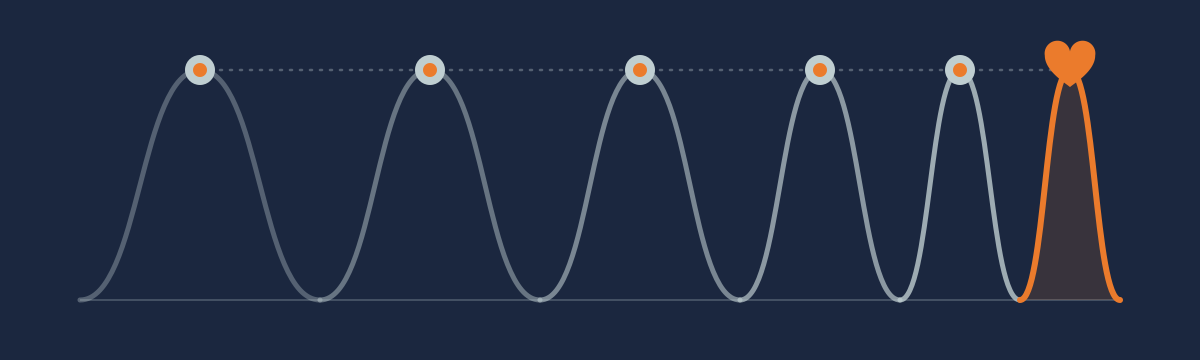
This innovation cycle drives the economy. Building on the work of Nikolai Kondratieff, Schumpeter described the resulting long economic waves and the industries that carry them: the steam engine and railways around 1845, electricity and the combustion engine around 190010. Strikingly, the waves are getting shorter.
The long waves of the economy
- 1785Water power, Textiles, Iron
- 1845Steam, Railways, Steel
- 1900Electricity, Chemicals, Combustion engine
- 1950Petrochemicals, Electronics, Aviation
- 1990Digital networks, Software, New media
- 2020Digitalisation (AI, IoT, robotics), Clean tech
Progress and decline
Technological innovation is an inevitable driver of economic development. In this understanding, however, it is not good in itself: by driving the cycle, it is responsible for progress and decline alike. The philosophy of innovation speaks of its “Faustian” character6,12. It also asks whether innovation is tied to technology at all. Are processes not at its core? And must innovation always produce new technology, as social innovation suggests it need not?6
For business, by contrast, innovation always takes the form of products and services. Its questions are correspondingly practical: Can innovation be predicted and planned? How is it managed, and how is it protected?
And in medicine?
Because innovation is so firmly linked to technology, the term is used in medicine almost exclusively for medical technology. But how does progress in medicine come about? How does it differ from the economic understanding of innovation? And can companies be the bearers of medical innovation at all?
Our understanding of innovation in medicine
For us, innovation in medicine does not begin with a product but with people. Its yardstick is not whether something sells, but whether people become healthier, receive better care and can find their way through the system. Medical progress often happens where no market rewards it: in better coordination between practice and hospital, in information people can understand, or in a therapy for a condition the industry finds unattractive.
Companies remain important, because hardly any therapy reaches patients without them. But they are not the only bearers of medical innovation. It needs research, care providers, payers, policymakers and patients working together. From this we derive three principles:
- Rethinking Health: We start from the problem in patient care, not from a technology in search of an application.
- Connecting Care: We bring together the stakeholders who must carry a solution, across sector boundaries.
- Creating Impact: We measure innovation by its effect on patients and society, not by novelty or revenue.
Understood this way, innovation is not a buzzword but a task: making sure that good ideas reach patient care. Our lighthouse projects show what this looks like in practice.
Sources
- Bayern Innovativ – Innovation leben. bayern-innovativ.de
- Cultures of Technology and the Quest for Innovation. Berghahn Books, 2006.
- Godin, B. Innovation Contested. Routledge, 2015. doi:10.4324/9781315855608
- OECD & International Development Research Centre. Innovation and the Development Agenda. OECD, 2010. doi:10.1787/9789264088924-en
- Christensen, C. M. The Innovator’s Dilemma. Harper Business, 2011.
- Blok, V. What Is Innovation? Laying the Ground for a Philosophy of Innovation. Techné: Research in Philosophy and Technology 25, 72–96 (2021). PhilPapers
- von Schomberg, L. & Blok, V. The turbulent age of innovation. Synthese 198, 4667–4683 (2021). Full text
- McKinsey & Company. What is innovation? 2022. mckinsey.com
- Schumpeter, J. A. Capitalism, Socialism and Democracy. With an introduction by J. E. Stiglitz. Routledge (first published 1942).
- Schumpeter, J. A. The Theory of Economic Development. Routledge, 2021.
- Neufeld, D. Long Waves: The History of Innovation Cycles. Visual Capitalist, 2021. visualcapitalist.com
- Blok, V. Philosophy of Innovation: A Research Agenda. Philosophy of Management 17, 1–5 (2018). Full text